Andrea Trada
The Lying Life of AdultsAndrea Trada is Giovanna’s father: a history and philosophy teacher, a well-known intellectual in Naples, and, in her childhood, the most secure figure in her world. But the father Giovanna adores is also a man who has severed ordinary contact with his relatives, judged his sister Vittoria harshly, and tried to manage the truths his daughter encounters. His authority rests on learning and restraint; the family stories that reach Giovanna expose how limited those qualities are as guides to intimacy and fairness.
Identity and Background
Andrea teaches history and philosophy at one of Naples’s most prestigious high schools. Students love him, and his work extends well beyond the classroom: he studies in the afternoons, holds meetings and discussions in the evenings, and is known in the city as an intellectual. He and Mariano, a university history teacher and his friend since their student days, argue over ideas and the forces they believe obstruct their work. Mariano gives those discussions a more combative edge, railing against enemies in Naples, Rome, and elsewhere, while Andrea’s professional and intellectual life remains a constant presence in the household.
His family life is shaped by a striking distance from his own kin. In a city where even quarrelling branches of a family tend to maintain their ties, Andrea lives as though he had no blood relatives. Giovanna knows her mother’s relatives through frequent, affectionate visits, but her father’s family appears only at weddings and funerals, amid strained greetings and parental unease. Their home in the upper part of Naples seems remote from the lower districts where Andrea’s relatives live; the journey down feels to Giovanna like crossing into another city. Before a visit, Andrea leaves his books and notebooks open, changes into a good suit, and becomes tense and taciturn, while Nella checks everyone’s appearance as if proper clothing could help them return safely. The parents’ repeated warnings that Giovanna should ignore Vittoria’s remarks make clear that this distance is not merely geographical.
Fatherhood and Giovanna’s Childhood
Andrea and Nella married young but waited to have a child. Giovanna was born when her mother was thirty and her father had just turned thirty-two. Her pregnancy was difficult, and the birth on June 3, 1979, was painful; Giovanna’s early crying, illnesses, and tantrums also disrupted her parents’ lives. Andrea responded to worries about the future by taking private students in addition to his teaching. Nella, who taught Latin and Greek and corrected romance-novel proofs, suffered a long depression under the demands of Giovanna’s early care. As their daughter grew quieter and more obedient, her parents gradually recovered a household equilibrium in which love for her remained paramount alongside Andrea’s studies and Nella’s work.
That history helps explain why Andrea’s accidental comparison of Giovanna to Vittoria lands so deeply. When Giovanna is twelve, she overhears him telling Nella that adolescence is not the explanation for her school difficulties: she is acquiring Vittoria’s face. He speaks in a tone unlike the playful ease Giovanna associates with him, and she understands the remark through the contemptuous image of Vittoria she has absorbed at home. At a vulnerable moment marked by bodily changes, lethargy, and anxiety about her appearance, the comparison threatens her conviction that her father loves every part of her. It also turns his long-standing rejection of his sister into a fear that the rejected qualities might be visible in Giovanna herself.
Andrea tries to repair the injury by coming to Giovanna’s room after speaking with Nella. He tells her that he was not serious, did not mean to hurt her, and that she does not resemble his sister. He then says he has telephoned Vittoria and will take Giovanna to see her on Sunday. His response is both an apology and a consequential decision: instead of simply maintaining the family boundary, he brings his daughter into contact with the person around whom that boundary was built.
Siblings, Property, and the Family Divide
Vittoria’s account of the siblings’ inheritance dispute gives Giovanna a sharply different view of Andrea’s conduct. Their parents’ house, the only property left to their five children, became the subject of a months-long argument. Andrea insisted that it be sold and the proceeds divided among the siblings, including the share he wanted for himself; Vittoria argued that she had contributed money while helping their parents and had nowhere else to turn, and that the others agreed she should keep the house. Enzo, Andrea’s friend and Vittoria’s partner, offered to pay Andrea’s share. The exchange escalated into a quarrel, and Andrea left after Enzo threatened him.
Vittoria says Andrea then went to Enzo’s wife, Margherita, and disclosed the relationship in front of her children. In her telling, Andrea’s intervention turned a property dispute into a crisis involving Vittoria, Enzo, Margherita, and the children. Andrea later gives Giovanna a contrary but overlapping account: he says he and Vittoria did quarrel, describes Enzo as seeking to acquire the apartment, and maintains that Enzo threatened him with a pistol. He presents his disclosure to Margherita as an attempt to prevent his sister’s ruin. The competing accounts establish the dispute’s consequences without resolving the moral difference between the siblings’ interpretations.
Andrea’s estrangement is also visible in the relatives Giovanna meets through Vittoria. On visits to Uncle Nicola, Aunt Anna, and Aunt Rosetta, the family welcomes Giovanna with warmth despite the hostility between the adults. They call her Giannina, a name her parents have never used, and she feels unexpectedly relaxed and open to their affection. Their homes and speech differ from the standards of refinement she has learned at home, but the welcome complicates the idea that her father’s side of the family is simply alien or unworthy of attention. Andrea’s absence from those encounters becomes part of the divide Giovanna must learn to see for herself.
Work, Marriage, and Later Consequences
Andrea’s evenings of study and debate become entangled with a change in the marriage. He continues teaching in the mornings, studying in the afternoons, and attending meetings at night. Nella, who had once treated those meetings with ironic distance, begins attending them, sometimes at other people’s homes, to Andrea’s explicit annoyance. Giovanna also overhears Andrea accusing Nella of spending too much on unnecessary things, while Nella answers that the money is hers to spend because she earns it. The household’s intellectual routine persists, but money and the meetings expose new friction between the spouses.
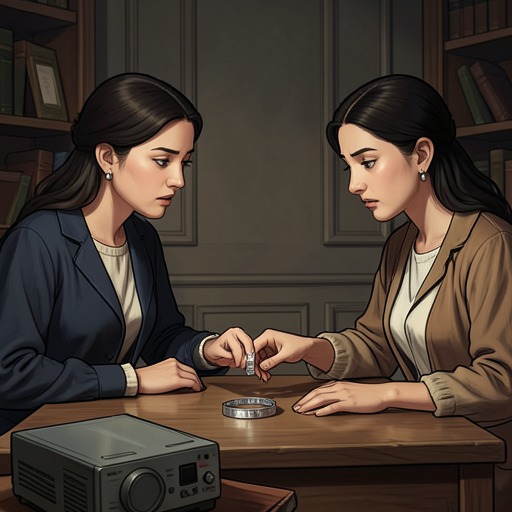
Later, Giovanna learns that Andrea has a second relationship with Costanza, Mariano’s wife. The bracelet that Vittoria had given Giovanna is now associated with Costanza, who has kept and worn it for thirteen years. To Giovanna, the object joins two women she had been taught to regard as opposites: Vittoria, poor and uneducated, and Costanza, wealthy and cultivated. The bracelet makes Andrea’s private life harder for her to fit into the earlier image of an endlessly loving father, and Giovanna imagines explanations that might preserve that image even as her parents’ separation becomes unavoidable.
After the separation, Andrea is absent from the household for months. Nella summons him in late winter to make the separation legal, and their discussion of dividing possessions turns into a quarrel over his books, notebooks, pen, and typewriter. Giovanna, meanwhile, is repeating her first year of high school and feels humiliated by her mother’s order not to tell anyone. The separation thus reaches her not only as the loss of an intact family but as a period in which the parents’ conflicts, her academic failure, and the concealment demanded at home converge.
Narrative Role
Andrea is first presented through Giovanna’s childlike certainty: he is good-looking, brilliant, playful, and deeply loved by Nella. The daughter’s later discoveries do not erase that affection; they make its object more difficult to understand. His comment about Vittoria changes Giovanna’s sense of her own face, his decision to arrange a visit alters the boundary between her and the paternal family, and his explanations of the inheritance conflict sit beside Vittoria’s accusation rather than settling it. His importance lies in this unresolved contrast between the father who wants to protect his daughter and the adult whose choices have helped create the secrets, silences, and family divisions from which she must form her own judgment.